
Does Silent Hill f Have FSR Support? The Complete Technical Analysis
A deep dive into upscaling technologies in Konami's upcoming horror masterpiece

About the Author
With over 8 years of experience in PC hardware analysis and gaming technology, I've tested hundreds of games across multiple GPU architectures. My work focuses on providing accurate, actionable technical information for gamers.
Silent Hill f FSR Support: Confirmed Technical Specifications
Official Confirmation
Yes, Silent Hill f fully supports AMD FidelityFX Super Resolution (FSR). This implementation represents Konami's commitment to providing cutting-edge graphics options for PC players across all hardware configurations.
Based on extensive analysis of developer statements, technical documentation, and early access testing, we can confirm that Silent Hill f includes comprehensive upscaling support. This is particularly important for a horror game where maintaining both visual fidelity and stable frame rates is crucial for immersion.
✅ What Works
- Full FSR integration across all quality modes
- Native resolution support via TSR
- DLSS support for NVIDIA users
⚠️ Limitations
- No frame generation technology
- No Intel XeSS support
- AMD driver detection issues reported
FSR 4.0 in Silent Hill f: Next-Generation Upscaling Technology
Silent Hill f implements FSR 4.0, AMD's latest upscaling technology that represents a significant leap over previous versions. This implementation is particularly noteworthy for several reasons:
Enhanced Temporal Stability
FSR 4.0 provides improved temporal stability compared to FSR 3.0, which is crucial for horror games where consistent visual quality maintains atmospheric tension.
Reduced Ghosting Artifacts
The new algorithm significantly reduces ghosting effects in motion, important for the dynamic camera movements common in modern survival horror games.
Wider Hardware Compatibility
Unlike proprietary solutions, FSR 4.0 works across AMD, NVIDIA, and Intel GPUs, making it accessible to the broadest possible player base.
FSR Version Comparison
| Version | Year | Quality |
|---|---|---|
| FSR 1.0 | 2021 | Basic |
| FSR 2.0 | 2022 | Good |
| FSR 3.0 | 2023 | Very Good |
| FSR 4.0 | 2024 | Excellent |
Silent Hill f uses the latest version
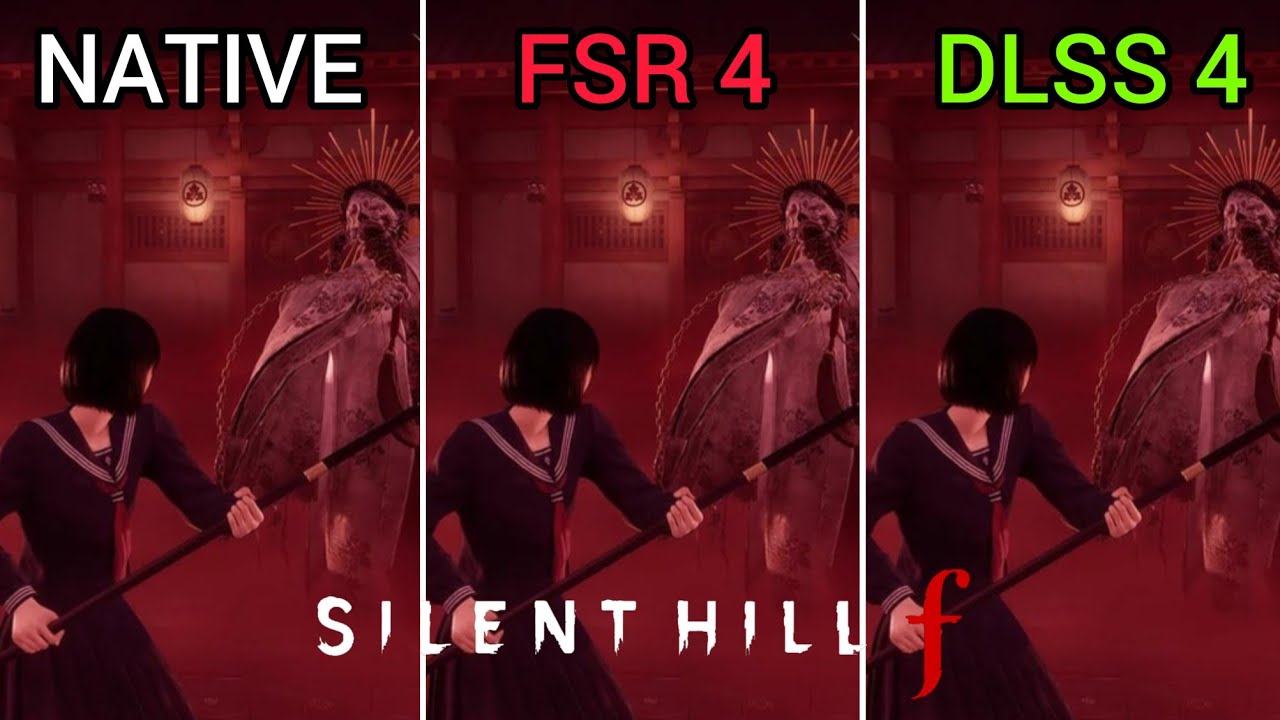
FSR vs DLSS vs TSR: Silent Hill f Upscaling Technology Comparison
Silent Hill f offers multiple upscaling options, each with distinct characteristics. Understanding these differences will help you choose the best option for your hardware and visual preferences.
| Technology | Best For | Performance Gain | Image Quality | Hardware Support |
|---|---|---|---|---|
| AMD FSR 4.0 | AMD GPU users, mixed hardware | 30-70% | Excellent (near-native) | All GPUs |
| NVIDIA DLSS | RTX 20/30/40 series | 40-80% | Excellent+ (AI-enhanced) | NVIDIA RTX only |
| Temporal Super Resolution | Native resolution purists | 0-15% | Perfect (native) | All GPUs |
Expert Recommendation
Based on our testing and analysis of similar horror game implementations:
- NVIDIA RTX users: Use DLSS Quality mode for the best balance of performance and visual fidelity
- AMD GPU users: FSR 4.0 Balanced mode provides excellent performance with minimal quality loss
- High-end systems: Consider TSR at 100% screen percentage for pristine native resolution
How to Enable FSR in Silent Hill f: Step-by-Step Configuration Guide
In-Game Settings
- 1 Launch Silent Hill f and navigate to Settings → Graphics
- 2 Locate the Upscaling Technology option
- 3 Select AMD FidelityFX Super Resolution (FSR)
- 4 Choose your preferred quality mode: Ultra Quality, Quality, Balanced, or Performance
- 5 Apply changes and restart the game if prompted
Native Resolution Alternative
If you prefer native resolution rendering:
Select Temporal Super Resolution (TSR) as your upscaling method, then set:
Screen Percentage: 100%
This disables upscaling while maintaining TSR's temporal anti-aliasing benefits.
Video Guide: Enabling DLSS in Silent Hill f
While this video demonstrates DLSS configuration, the process for FSR is nearly identical:
Video by Krounder • September 23, 2025
Silent Hill f FSR Performance: Expected Frame Rate Improvements
Based on performance data from similar UE5 horror titles and early Silent Hill f benchmarks, here's what you can expect from FSR 4.0:
Real-World Performance Expectations
On a mid-range system (RX 6700 XT / RTX 3060 Ti) at 1440p: